
Guide vs. Self-Guided Adventure Travel: How to Choose What’s Right For You
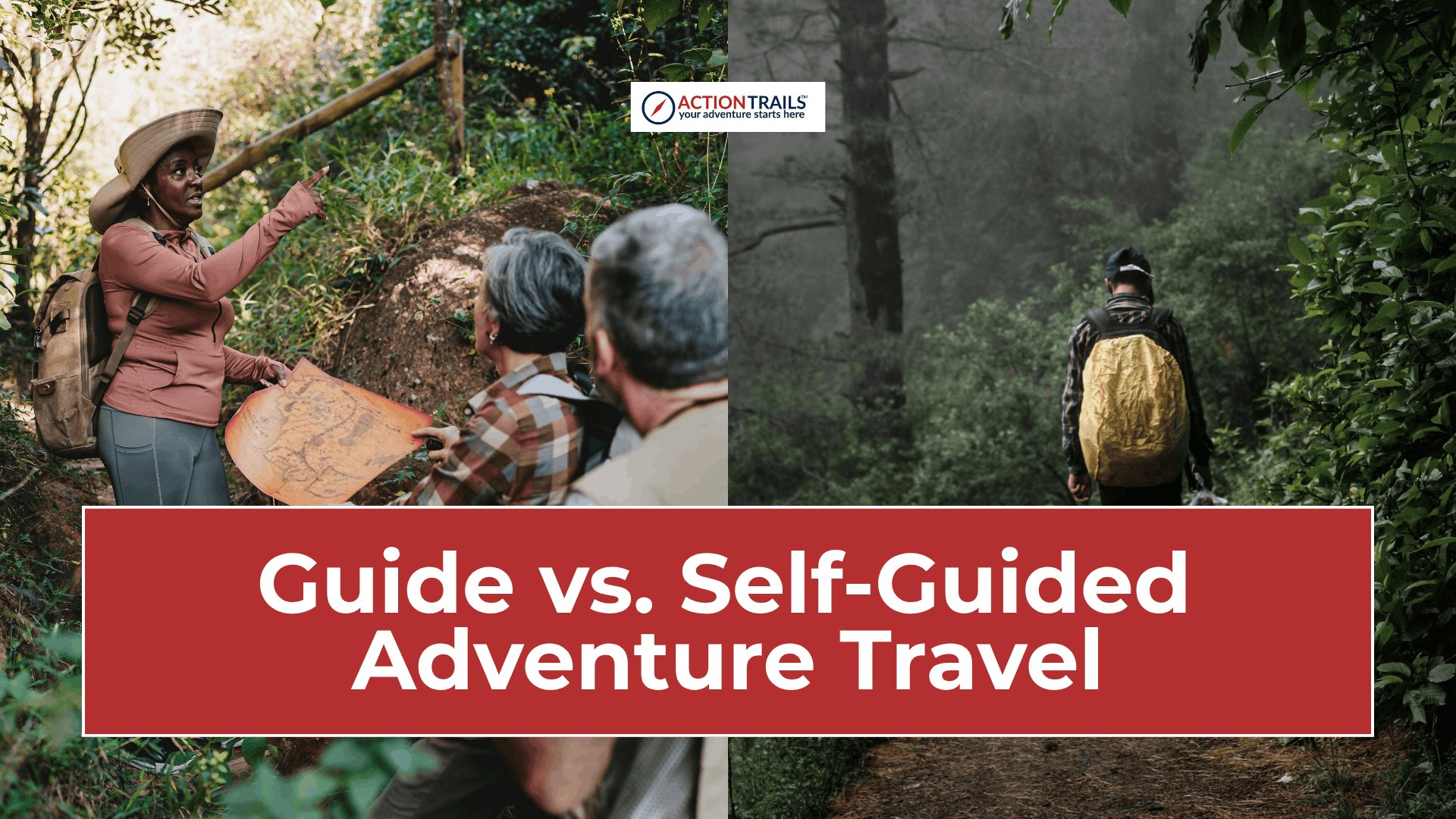
Picture a trailhead at seven in the morning. The air is cold enough to see your breath, the car park is half empty, and two groups are getting ready. One is a cluster of ten people in mismatched jackets, listening to a woman in a faded cap explain where the day’s first climb will start and where the last of the water is. The other is a couple bent over a phone, arguing amiably about whether the blue dot is where it should be.
Both groups will probably have a wonderful day. That’s worth saying early, because the debate over guided adventure travel versus doing it yourself is usually conducted as if one of those groups is making a mistake. We don’t think so. We think they’ve made different trades, and the useful thing for a traveler is to understand what each trade costs and what it buys before booking anything.
So this isn’t a verdict. It’s a way of thinking it through, drawn from a lot of conversations with readers, guides, and the people who run these trips for a living. By the end, you should know which kind of trip suits you, or at least which questions to ask yourself in the shower tomorrow.
Why guided adventure travel isn’t just for beginners
A persistent idea in outdoor circles holds that real travelers don’t need guides, and that hiring one is a confession of inexperience. It’s a handsome theory, and it falls apart as soon as you talk to anyone who has done serious travel.
Experienced people hire guides all the time. They do it when the terrain is outside their specialty, when the permit system is a maze, when the trip is in a country where they don’t speak the language, or when they simply want to learn something. A strong rock climber might be a nervous navigator. A seasoned long-distance walker might know nothing about glacier travel. The most capable travelers we know are often the quickest to say, “I’m going to pay someone who does this every week.”
There is also a quieter reason. A good Provider makes a place richer, and experienced travelers know it. The first time you walk a valley with someone who grew up there, you realize how much you would have missed alone. They know which village makes the good cheese, why the chapel sits where it does, and what the old men are looking at when they study the sky at breakfast. Guided adventure tours, at their best, are less about being led and more about borrowing a lifetime of local attention for a week.
The myth that going alone is purer
The opposite myth is just as sticky. It says that independent travel is the honest kind, and that anything with a schedule and a guide is a sanitized imitation. This also deserves a gentle push.
Going without a guide gives you real things: freedom, privacy, the satisfaction of a problem solved by your own hands. But it doesn’t make you more authentic by default. Plenty of independent travelers follow the same guidebook route as everyone else, stay in the same hostels, and photograph the same viewpoint, just without anyone explaining it. Authenticity comes from attention and curiosity, and you can bring both to a guided trip or leave both at home on a solo one.
The truth is that a self-guided tour is often a perfectly polished product too. Someone has designed the route, booked the beds, and arranged for your bags to arrive at the next stop. It’s a more independent experience than a group departure, but it’s hardly wilderness. That isn’t a criticism. It’s a reminder that the question is rarely “guided or authentic.” It’s “how much support do I want, and where do I want it?”
What a day on the trail actually feels like
It helps to forget the brochure and imagine a normal day on each kind of trip.
On a guided trek, you wake to coffee that someone else made. Breakfast is on the table, the day’s plan has been explained, and your bag has been picked up or packed. You walk at a pace that suits the group, which means sometimes slower than you’d like and sometimes faster. The guide stops at the right moments to point out something or tell a story, and you find, to your surprise, that you’re noticing more than you normally do. Lunch is somewhere scenic and already sorted. The afternoon ends with a bed you didn’t have to find and a dinner conversation with people who, a few days ago, were strangers.
On a self-guided trip, the day begins with you. You decide when to leave, check the route, and pick a pace. You stop when the view demands it and keep going when it doesn’t. There’s a little more thinking involved: whether that junction is the right one, whether to push on or call it early, and where to eat. Some of that thinking is a pleasure, and some is a mild irritation, and you’ll discover which as the week goes on. At the end of the day, there’s a booked bed, a quiet table, and nobody to talk to but your companion, which is either exactly what you wanted or a little lonely.
Neither day is better. They simply ask different things of you. If you’d rather be taken care of, guided is the answer. If you’d rather be in charge, it isn’t.
When the terrain makes the decision for you
There’s one situation where we’ll stop being diplomatic. When the terrain is serious, hire a guide.
Serious means a few things. It means glaciers, where crevasses hide under snow bridges that look solid and aren’t. It means high altitude, where the early signs of trouble are subtle, and the correct response is unpleasant, such as turning around at the very point when you feel you are almost there. It means exposed ridges, whitewater, and remote country where the weather can change fast, and help is a long way away. In places like these, a guide is not a convenience. A guide brings judgment built on hundreds of days in the same conditions, and judgment is the one thing you can’t pack the night before.
Some destinations make the choice for you by law. Peru’s Inca Trail can only be walked with a licensed operator, and Kilimanjaro climbers in Tanzania must go with an authorized company. But even where nobody requires it, it’s worth asking yourself a simple question. If something went wrong at the farthest point of this itinerary, how long would it take for help to arrive? If the honest answer is measured in hours or days rather than minutes, think carefully about whether you’re the right person to be making the calls.
The flip side deserves equal weight. On well-trodden, well-marked routes through inhabited country, where there’s a village or a hut every few hours, the case for a guide is far weaker. Plenty of people walk the Camino or the Cotswold Way without a leader, and they do fine. The terrain tells you most of what you need to know, if you’re willing to listen.
What guided adventure travel costs compared with going alone
People tend to treat price as the tiebreaker, so let’s look at it honestly. A guided trip costs more than a self-guided one. That’s not up for debate. What’s up for debate is how much more, and what you get for it.
A small-group guided departure usually bundles the guide, lodging, most meals, and local transport. Because the guide’s fee is split among everyone, the per-person cost is lower than you might expect, and when you add up what a comparable independent trip would cost, the gap narrows. A private guided trip is a different story. You’re paying for the whole guide, plus the flexibility to set your own dates and pace, and the price reflects that.
Self-guided pricing sits in two layers. A packaged self-guided tour, in which a company designs the route, books the lodging, and moves your luggage, lands in the middle. Doing everything yourself is cheapest on paper, but you’ll pay in time, in planning, stress, and sometimes in gear you don’t yet own.
Whatever you’re comparing, ask what’s missing from the price. Park fees, permits, airport transfers, rental equipment, tips for porters and local crew, and insurance are the line items that turn a bargain into a surprise. And on a demanding route, think of the guide’s fee as part insurance. What you save by going without is, in a very real sense, what you’re spending on risk.
Who’s coming with you
A surprising amount of this decision depends not on the destination but on the company.
Solo travelers face the hardest choice, because they’re pulled in two directions. A small-group trip offers instant companionship and a built-in safety net, which many solo travelers value more than they expected to. Independent solo travel offers the most freedom, but with no one to share decisions or catch your mistakes, it demands more caution. We’d say that first-time solo adventurers should lean guided and then loosen up as their confidence grows.
Couples often do beautifully on self-guided trips. They have each other for conversation and shared decision-making, and the privacy is part of the appeal. The usual caveat is that a couple’s differing fitness levels are more visible when nobody else sets the pace, so choose an itinerary with a bail-out option or two.
Families with children are a special case. Younger kids tire unpredictably, teenagers get bored, and grandparents move at their own tempo. A guide who can adapt on the fly, adding a swim stop here, shortening the day there, is worth a lot. Many families find that a guide for the first day or two sets the tone for the whole trip.
And groups of friends can go either way. If everyone is at a similar level and no one minds a debate over lunch, independent travel works. If the group is mixed, or if you want everyone to relax rather than manage one another, bringing in a guide often saves more friendships than it strains.
How to choose a guided adventure travel company
So you’ve decided to book. How do you pick? The industry is crowded, and adventure travel companies, such as ActionTrails, are only part of the picture: the Providers behind the trips vary wildly in quality.
Start with the guides. Ask what first-aid qualifications they hold, and for technical terrain, what recognized mountain, climbing, or river certifications they carry. More revealing, ask how long they’ve worked in the particular region. A guide with ten seasons in the same valley knows things no certificate can teach. Operators that employ local guides, pay them well, and keep them year after year tend to deliver trips with a depth you can feel, and that’s a pattern worth looking for. If you book through a platform like ActionTrails, look at each listing for who actually leads the trip and what the guides’ background is.
Next, group size. For hiking guided tours, six to twelve people is generally the sweet spot, because it’s small enough for the guide to know each person and large enough for good company. Past fifteen, the guide becomes a crowd manager, and the experience starts to feel processed.
Then look at how the company handles uncomfortable questions. A good Provider will talk freely about safety, emergency plans, communications equipment, and weather decisions. They’ll tell you plainly if your fitness isn’t up to a route, and they’ll sometimes steer you to an easier one. If you get vague answers or a hard sell, move along. Read recent reviews from independent sources too, and notice how the company replies to complaints. Anyone can write a warm paragraph about a perfect week. The response to a bad one is the real test.
The same rules apply to self-guided packages. Ask how reliable the luggage transfers are, how detailed the route notes are, what happens if you get injured, and whether a real person picks up the phone. A booking platform like ActionTrails can help here, because you can compare routes, inclusions, and reviews for different adventure packages in one place before you commit, which is far harder to do when you piece the trip together alone.
The in-between option
It’s worth remembering that you don’t have to choose one approach for an entire trip.
One popular pattern is to start with a guided segment, learn how a region works, and then continue on your own. Another is to follow a self-guided route but hire a guide for the single hard day, a glacier crossing, or an exposed ridge. A growing number of companies now offer a guide on call, someone local you can phone and who will meet you at key points. Families do something similar, using a guide for the opening days and then carrying on independently with more confidence than they arrived with.
These hybrids work because they match support to risk. You pay for expertise where it counts and enjoy independence where it doesn’t. If you’re new to adventure travel, they are also the gentlest way in.
Three trips, three answers
To make this concrete, consider a few typical trips.
Say you’re planning a hut-to-hut walk through the Dolomites. The paths are well marked, the huts serve hot meals, and the weather, while changeable, is manageable for a prepared walker. This is a natural territory for a self-guided tour, particularly if you’ve walked in the mountains before. If you haven’t, a guided departure will teach you the habits of hut life, like early starts, shared dormitories, and the etiquette of the boot room, and you’ll be glad you went with someone who knew them.
Now imagine a multi-day trek in Patagonia. The scenery is staggering, and the weather is famously unforgiving, with wind that can knock you sideways and rain that arrives sideways too. Many walkers do the popular circuits on their own, but the margin for error is thinner than it looks, and logistics such as campsite and refuge reservations can be tricky. A guided trip takes the pressure off, and a guide who reads the sky well can be the difference between a miserable day and a magnificent one.
Finally, consider a week of sea kayaking along a remote coast. Here, the argument for guided adventure travel is almost overwhelming. Tides, currents, and sudden weather changes make this a place where experience matters more than enthusiasm, and the consequences of error are serious. Few people should attempt it without a professional, and the ones who can already know who they are.
Making your choice
If you take one thing from all this, let it be that the right answer depends on the trip and on you, and that both can change from year to year. A traveler who wants to be looked after in the Himalaya may want to be left alone in the Lake District. A first-timer who books a guided week may well come home and plan a solo route for the next summer. That’s the system working as it should.
When you’re deciding, ask yourself four things. How serious is the terrain, and how far is help? How much experience do you actually have, not how much you’d like to have? How much time and energy do you want to put into planning? And what do you hope to feel at the end of the week? Look after the first two questions honestly, and the other two will usually answer themselves.
Then pick something, go, and stop agonizing. The two groups at that trailhead at seven in the morning will have walked off by eight, and by the afternoon, neither will be thinking about how they got there. They’ll be thinking about the view, the weather, and whatever is for dinner. That’s the point of the whole business, and it’s waiting for you whichever way you choose to go.